
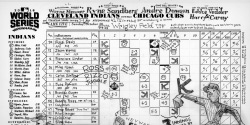

Fun to draw for a win
It’s rather funny how doing public scorecards changes your perception of the game. You want the win, not just for the win; but because a win usually comes with some good events to highlight. A home run, maybe. Or some stellar defense.
Doing a scorecard when your team doesn’t do anything especially spectacular is a bit challenging. Although I should remember what it’s like to do a scorecard just for myself during the regular season. This is the World Series. You can always find at least one record being set in the game.
During the regular season, if there was even the tiniest of records set, you know that would become the focus of the card. And now with these World Series cards, I’m overflowing in trivia.
Game five was such an incredible game with so many moments to illustrate.
New illustration style introduced
With the illustrations on this card, I developed a new style using straight lines on a angle.
Scorecards have lots of lines in a grid. And then within the grid we write in angled lines for any hits. The angled lines in these illustrations mimic the lines written on a scorecard. This style all started with the Kris Bryant illustration. You actually can’t see the full illustration on the scorecard, because I cropped it off. While sketching Bryant swinging, I noticed many continuous straight lines throughout the forms in his body. I figured I’d roll with the straight lines to simplify the process of drawing these illustrations. (Photo reference from USA TODAY Sports, Jerry Lai)


Bryant’s turnaround

Before Bryant’s home run, the Cubs team batted .197 in the World Series (29 for 147). After Bryant’s home run, they batted .323 (32 for 99).
Just as Bryant’s home run was a pivotal moment for the Cubs, my drawing of him was a pivotal moment for my illustration style in the scorecards.
And by the way, Bryant’s home run had the second most impact of all nine home runs hit in the 2016 World Series.
One of my favs
One of my favorite illustrations from the entire series is the next illustration I did of Jason Hayward climbing the outfield wall (photo reference from Brian Cassella, Chicago Tribune). The angular Cubist style has a great fit with the shapes of this subject. The flat angled wall, with Hayward’s arm laying across it. His body leaning backwards, head titled up. Even his legs bending up—everything had such an interesting volume that worked with the lines.


Plus, the location of the illustration integrated very well into the scorecard. The play on the scorecard grid appeared just above the illustration. The P9 inside a circle looks like the actual ball that Heyward is catching.
Cubs turn of fortune
You knew game 5 was off to a good start when Jon Lester struck out the first three batters in a row. Then in the second inning David Ross and Anthony Rizzo performed a spectacular team catch in foul territory. Carlos Santana hit a high pop foul that bounced out of David Ross’ hands, then bounced out of Rizzo’s hands, Ross flipped upside down, and finally Rizzo caught the ball. This incredible catch showed good fortune turning to the Cubs side.


Cubist influences
This scene makes for a very fun cubist style drawing. Three ways this drawing embodies cubism:
- Faceting
All the body angles and shapes mimics Cubism’s faceting and simplification of geometric forms. - Patterns
The pinstripes on the Cubs home uniforms really helps with the energy in the shapes and lines. These pinstripes form a pattern. Textures and patterns were often employed in Cubism. - Capturing span of time
This particular play shows three moments in time all layered into one illustration. One of the Cubism’s aspects is capturing a span of time into one canvas.
An indirect influence on the cubist nature of these drawings might have come from my smudge sheet. Wait–what’s a smudge sheet? I fill out a detailed scorecard over the course of a three-hour baseball game, and then I burn additional six hours with post-game details. In total one sheet of paper is worked for nine hours straight. The sheet starts to get full of graphite which can easily smudge as my hand touches the sheet. I place a sheet of paper on top of the scorecard to prevent my hand from smudging the already-existing text and drawings.


I could use a blank sheet of paper, but I found that putting raw paper on top of a drawing will cause the drawing to smudge. The teeth of a raw sheet of paper is enough to smudge a drawing underneath. My smear sheet needs to have a surface that will not rub against the drawing.
A printout with solid color from a laser printer forms a nice smooth non-smearing surface. Just try drawing with a pencil on top of a color laser printout. You’ll find that the pencil marks don’t grab onto the surface. The color toner forms a sort of seal on the paper that prevent pencil from adhering. Thus, a color printout makes for a great smudge sheet!

The printed paper I used throughout the 2016 World Series was a print of a Juan Gris painting, “Still Life with a Guitar” from 1913 (the image is available in the public domain via The Metropolitan Museum of Art’s website). Within the first week of my daughter’s birth, I photographed her on top of prints of artwork from famous artists, including this one. It’s a really cute series. Tiny baby on top of paintings by famous artists.
Thus, I have prints of artwork sitting around. I initially used this one, because it had lots of heavy toner coverage–just what is needed for a smudge sheet. At the time when I picked this particular print, I thought about how cool it would be if the cubist style somehow had an influence on how I drew the scorecards. Heh. Lo and behold, it did!
Chapman’s longest career appearance
Joe Maddon ripped a page out of the Indians manager’s playbook by having the Cubs closer come into the game at the 7th inning. Terry Francona often likes to have pitcher Andrew Miller come in the middle of the game to break the spirit of the opposing team.
Throughout Aroldis Chapman’s career he’s always been just a 9th inning pitcher. Of his 398 career appearances, he’s worked one inning or less 363 times. The longest outing he ever went was 2.1 innings. He only went 2 innings 14 times. That’s 3% of his appearances.


With the Cubs up by only one run, Aroldis Chapman entered the game in the 7th inning with one out. (photo reference USA TODAY Sports, Dennis Wierbicki). Then he pitched again for the entire 8th inning. And he even pitched the entire ninth inning. Everyone was shocked. He threw major heat during all those innings. 19 of his 42 pitchers were over 100 MPH.
Art series for World Series
It’s been great fun filling out these scorecards. Normally I just do one scorecard a year for my annual trip to Wrigley (sometimes two trips). I’ve never done a consecutive back-to-back-to-back series of games. It’s interesting to develop the style of the cards. For instance, the angular style in this game 5 card is totally new for me.
For game six, I continued this angular illustration style, and incorporated some typography that enhances this look.
Game five factoids
Pre-game
- Attendance 41,711 (101.9% full)
- 50 degrees wind blowing in 10mph
- Cleveland leads series 3-1
- National anthem: Wayne Messmer
- Game ball delivery: Andre Dawson
- First pitch: Ryne Sandberg

1st inning (top) Cleveland Indians batting
- First pitch strikes at 7:17pm CST
- Jon Lester strikes out the side
1st inning (bottom) Chicago Cubs batting
- Anthony Rizzo hits monster foul on Sheffield, eventually flies out to left field.
2nd inning (top) Cleveland Indians batting
- Jose Ramirez hits a 383-foot home run
- Third baseman Kris Bryant makes a diving play on Brandon Guyer’s ground ball
- Catcher David Ross and first baseman Anthony Rizzo juggle and catch a pop foul ball

3rd inning (top) Cleveland Indians batting
- Jason Hayward climbs the right field wall to catch a foul ball
4th inning (top) Cleveland Indians batting
- Catcher David Ross and first baseman Anthony Rizzo once again have an interactive foul ball catch
4th inning (bottom) Chicago Cubs batting
- Anthony Rizzo hits double off the ivy
- David Ross becomes the oldest catcher to knock in a run during a World Series game
- Kris Bryant hits lead-off home run. Second youngest Cub to homer in World Series.

5th inning (bottom) Chicago Cubs batting
- Kris Bryant steals second. Becomes first Cub player ever to hit a home run and steal a base in a World Series game.
7th inning (top) Cleveland Indians batting
- Brand Guyer hit by pitch, just grazed his leg
7th inning (middle)
- Eddie Vedder sings 7th inning stretch with Harry Caray

7th inning (bottom) Chicago Cubs batting
- Dexter Fowler hit by pitch on his foot. Ouch.
8th inning (top) Cleveland Indians batting
- Aroldis Chapman doesn’t cover first base on Rajai Davis grounder to first base
- Rajai Davis becomes sixth player ever to steal three bases in one World Series game. Oldest player ever to do so (36 years)
8th inning (bottom) Chicago Cubs batting
- Jason Heyward hits monster foul on Sheffield, later singles, and then steals two bases. First multi-steal game by a Cub in World Series since Billy Jurges game 3, 1932
9th inning (top) Cleveland Indians batting
- Aroldis Chapman pitches three innings
Summary
- Second time in Cubs World Series history Cubs allow no walks! (1908 Game 4)
- Three hours, 27 minutes
- Cubs win. Cleveland 2, Chicago 3
Julia factoid
30 minutes before tonight’s Cubs game, we tried on Julia’s Cub costume for her to become a baby ewok!

Dedication
Dedicated to Cubs fans who passed away just short of the 2016 World Series
- Kenneth Majors 8/10/1944 – 10/9/2016
- Lindsay K. West 7/29/1988 – 10/20/2016
- Stephen M. Swide 7/25/1947 – 10/19/2016
- Carles A. Abbott 1/12/1941 – 10/13/2016
Game 5 promos Chicago magazine ran on social media

Chicago magazine website
“What a catch! What a home run! WHAT A WIN!”
Facebook post
“Relive all of last night’s thrilling action.”
Twitter
“WoW! Relive last night’s thriller with @mattmaldre’s one-of-a-kind scorecard”
Twitter
“Relive #WorldSeries Games 1-5 through gorgeously hand-drawn scorecards.”
Twitter
“Relive last night’s @Cubs win in its hand-drawn scorecard glory”
The Bryant promo for game 5 that wasn’t run by Chicago magazine:

Tomorrow’s scorecard
The game 6 scorecard is a GRAND SLAM! Stay tuned for the triple-homer game.