

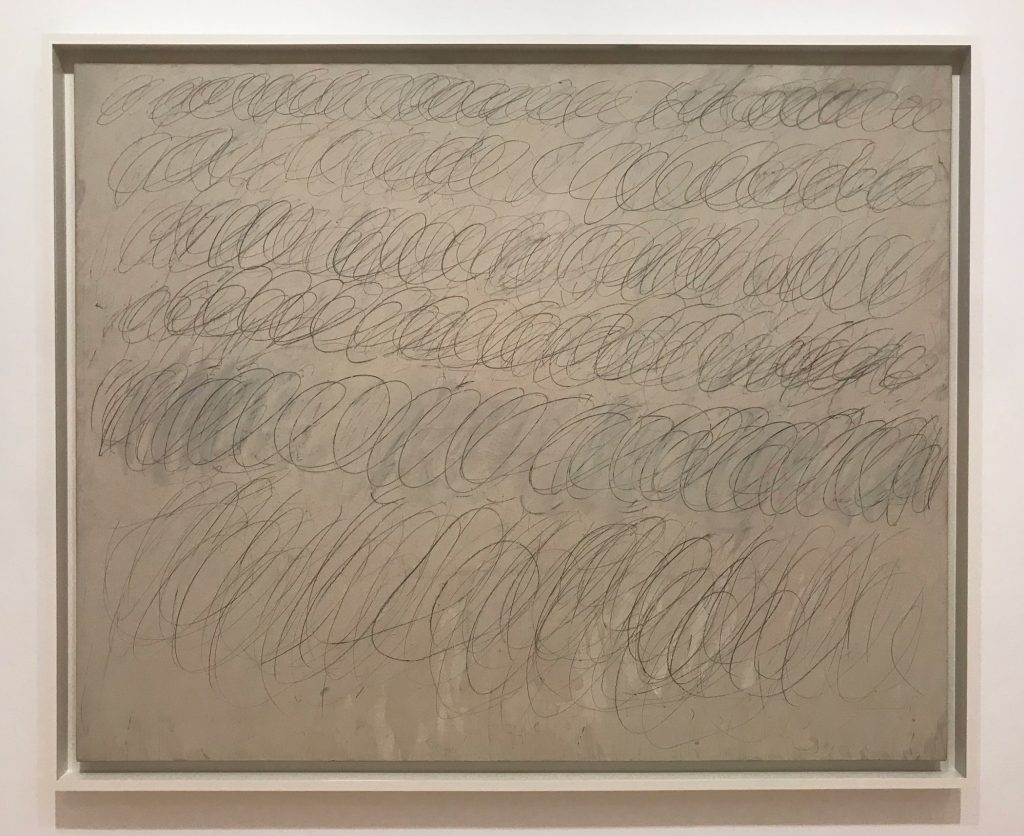
When most people hear the name Cy Twombly, they think of abstract expressionist art – large canvases filled with emotional scribbles and marks that often prompt comments like “my toddler could do that.”
Cy Twombly is an important artist because he broke the rules of traditional painting to create something deeply emotional and unique. He showed that art doesn’t have to look realistic or polished to be powerful. Instead, it can express big ideas—like love, history, or nature—through simple marks, scribbles, and gestures.
There’s a fascinating baseball connection that few know about: Cy Twombly’s father was a pitcher for the Chicago White Sox in 1921.
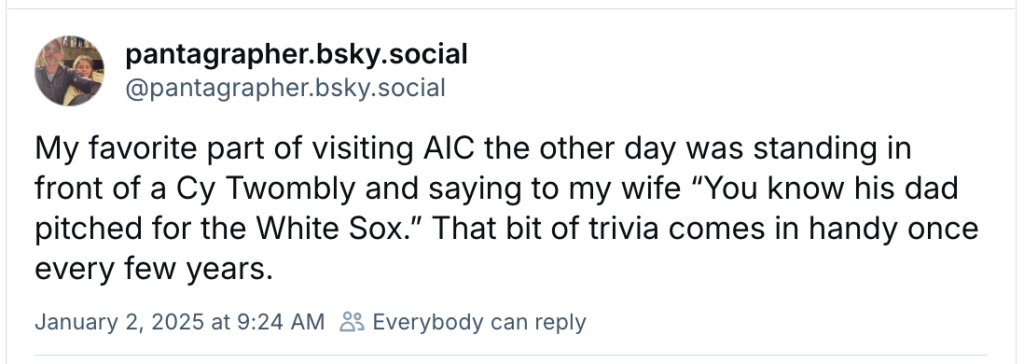
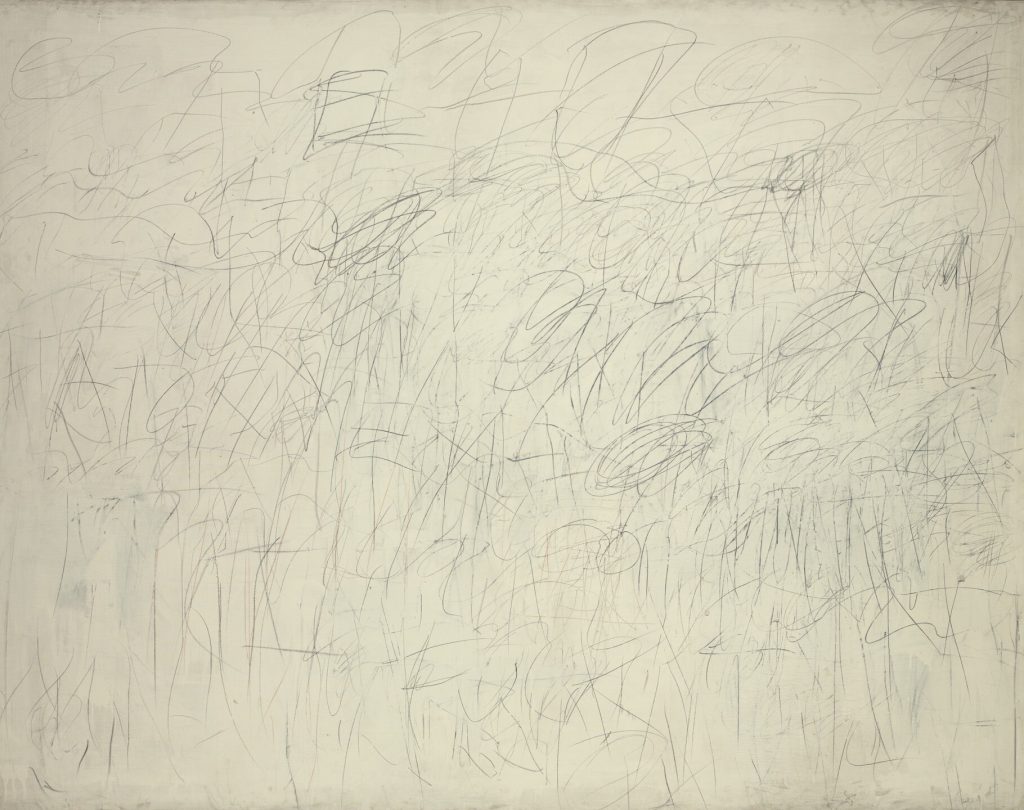
Both father and son were named after the legendary pitcher Cy Young, creating an intriguing intersection of baseball and fine art. The elder Cy took to the mound, while his son would later revolutionize modern art. Cy Twombly (1928-2011) would become one of the most significant artists of the 20th century, known for breaking traditional artistic conventions to create deeply emotional and unique works.
What about Cy Twombly the pitcher? How did he perform in 1921?
The elder Cy Twombly’s major league career was brief. He appeared in just 7 games for the 1921 White Sox.
- Started four games
- Finished three other games
- 5.86 ERA
- 1-2 record
- -0.1 pitching WAR
Cy Twombly is a bit of an enigmatic figure. Not much information is available on him. Even his profile picture on baseball-reference.com is an obscure image.

His best game was his first on June 25, 1921
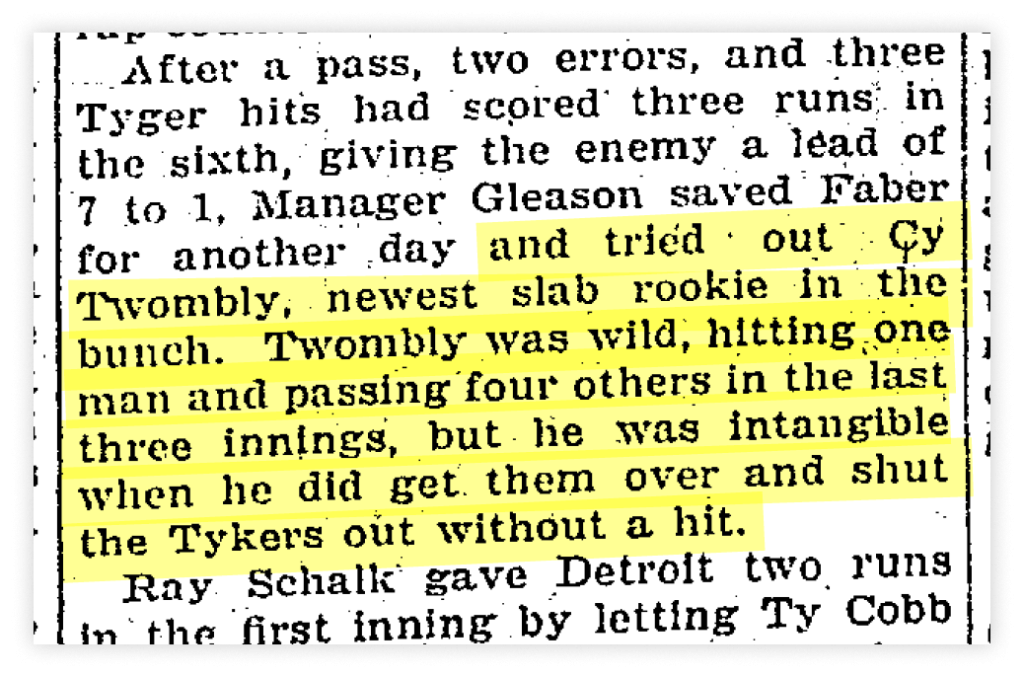
His most memorable performance came in his debut on June 25, 1921. In that game against the Detroit Tigers, Twombly entered in the seventh inning with his team trailing 7-1. (The Tigers were in 7th place, the White Sox in 5th place)
Twombly closed out the game allowing no hits over three innings. Although the very first batter he faced, he hit with a pitch.
In the 8th inning, he walked three batters. Then he faced the great Ty Cobb with the bases loaded and two outs.
Cobb was batting .399 at the time. One more hit, and he would be over .400. Twombly got Cobb to ground out 3B-1B to end the inning.
Cobb must have been rattled by his groundout. In the next half-inning, Cobb booted a ball in center field, allowing two runs to score.
This would be a fun game to make a scorecard
The scorecard could be done in Cy Twombly’s scribble style. The ethos of Twombly’s art can also be applied to scorecards. As I think about Cy Twombly the artist, I think about how he can be applied to scorecard art.
This intersection of baseball and modern art offers an opportunity to think about both differently. The younger Twombly’s artistic principles can actually teach us something about appreciating baseball, particularly in how we record and remember the game. His approach to art – embracing imperfection, connecting past to present, and finding beauty in the unconventional – parallels how we might think about baseball scorekeeping.
1. Cy Twombly made art feel personal and raw
Twombly’s paintings look like a mix of doodles and notes, almost as if someone scribbled their deepest thoughts on a wall or in a diary. This makes his work feel more human and relatable, even if it seems messy at first glance.
Similarly, the best scorecards are the ones that are personal. They don’t just record the game; they record the scorer. Notes in the margins, doodles in empty spaces, or even an unplanned coffee stain all add character, making the scorecard a reflection of the moment and the person behind it.
2. Cy Twombly connected the past to the present
He took inspiration from ancient myths, poetry, and history and brought them into modern art. For example, he might reference Greek gods or famous love stories but express them in a way that feels alive and immediate.
Scorecards, by their very nature, are records of the past. A great scorecard doesn’t just capture what happened on the field; it connects those events to a larger story. Perhaps it recalls a similar play from years ago or highlights a record broken that day. Through thoughtful notes, the scorecard becomes a bridge between eras, much like Twombly’s art.
3. Cy Twombly changed what art could be
At a time when many artists were focused on making bold, dramatic statements, Twombly dared to be subtle, quiet, and poetic. His work challenged people to think about art differently—not as something to “understand” but as something to feel.
Scorecards often aim for perfection, with every box neatly filled. But what if we thought of them differently? Instead of sterile records, scorecards could be creative, even playful. Imagine using color to emphasize key moments or adding poetic descriptions to key plays. A scorecard could become more than a record – it could be a piece of art.
4. Cy Twombly showed the beauty in imperfection
His scribbles and smudges might look like mistakes, but they’re deliberate and full of meaning. He helped people see that imperfection is a part of life—and that it can be beautiful.
Accidents on a scorecard, like a smudged pencil mark or mustard dripped from a hot dog, capture the true memories of a game. These imperfections tell the story of the day – not just the game, but the experience of being there. They remind us that the beauty of baseball is as much in the messy, unscripted moments as it is in the carefully executed plays.
5. His art speaks to big emotions
Even if you don’t know the myths or stories he’s referencing, Twombly’s art conveys universal feelings like passion, longing, or the passing of time. You might see chaos, sadness, or joy in his lines, depending on your own mood or perspective.
I like to add marginalia and comments to my scorecards, but what if they captured the mood of the game itself? If it was a dark and rainy day, the scorecard could reflect that with a somber, overcast aesthetic. If it was an exciting, high-energy game, the scorecard might have bold, vibrant flourishes. By infusing the scorecard with emotion, it becomes a more dynamic and meaningful record.
Why Cy Twombly matters today
Twombly’s art encourages people to let go of the idea that art has to “look good” or “make sense” to matter. His work invites you to slow down, feel, and find your own meaning. In a world that often prioritizes perfection and clarity, Twombly reminds us of the beauty in being messy, vulnerable, and real.
Let’s allow our scorecards to be messy and real. Let them be personal, imperfect, and full of emotion. Like Twombly’s art, they can be more than what they seem – a celebration of the game, the day, and the person recording it.
What it was like for the Cy Twombly and the White Sox in 1921
We all know about the 1919 Black Sox scandal. Players made bets to lose. Players were banned for life. However, those bans didn’t happen right away. For most of the 1920 season, those players continued to play.
The scandal didn’t become public until the end of the 1920 season on September 26, 1920. Only at that point were the players temporarily suspended.
On August 4, 1921, a Chicago jury found the players not guilty. (Yes, NOT guilty). But… as SABR says:
New baseball Commissioner Judge Kenesaw Mountain Landis did not care about the jury’s decision. He felt that this would send a message to gamblers and the American public that major-league games had, nonetheless, been fixed. Thus, he ruled that these eight “Black Sox” players were permanently barred from Organized Baseball.
The suspension from September 1920 was made into a permanent forever ban from baseball.
Therefore, the 1921 season was the first season when the White Sox were without their best players. Cy Tombly came during this whole sentiment when the fans lost interest, because of their favorite players cheating.
Other trivia points about Cy Twombly’s best game
Ty Cobb played a big part of the Cy Twombly game. What was it like for Twombly to face Cobb with the bases loaded?
At that point in Cobb’s career, he lead the league in average 12 times and stolen bases six times. Cobb wasn’t just a singles hitter, he lead the league in OPS+ 11 times.
In this game, Cobb was 34 years old, he would finish the 1921 season batting .389, second behind teammate Harry Heilmann’s .394. (I never heard of Heilmann, but he lead the AL in AVG four times). Cobb was also third in OPS with 1.048 behind Ruth’s 1.359.
Mostil day?
How about the newspapers reporting of the game? Oddly enough, the Chicago Tribune reports this as “Mostil day” after the White Sox centerfielder Johnny Mostil.
Who was Mostil? Why did he have his own day? Was he some great White Sox player? Not really. This was his rookie season. He was batting .299 on June 25. Eventually, in 1926, he finished 2nd in MVP voting. But this was 1921. What caused such popularity for Johnny Mostril that he would have his own day?
The Chicago Tribune reports on June 26, 1921
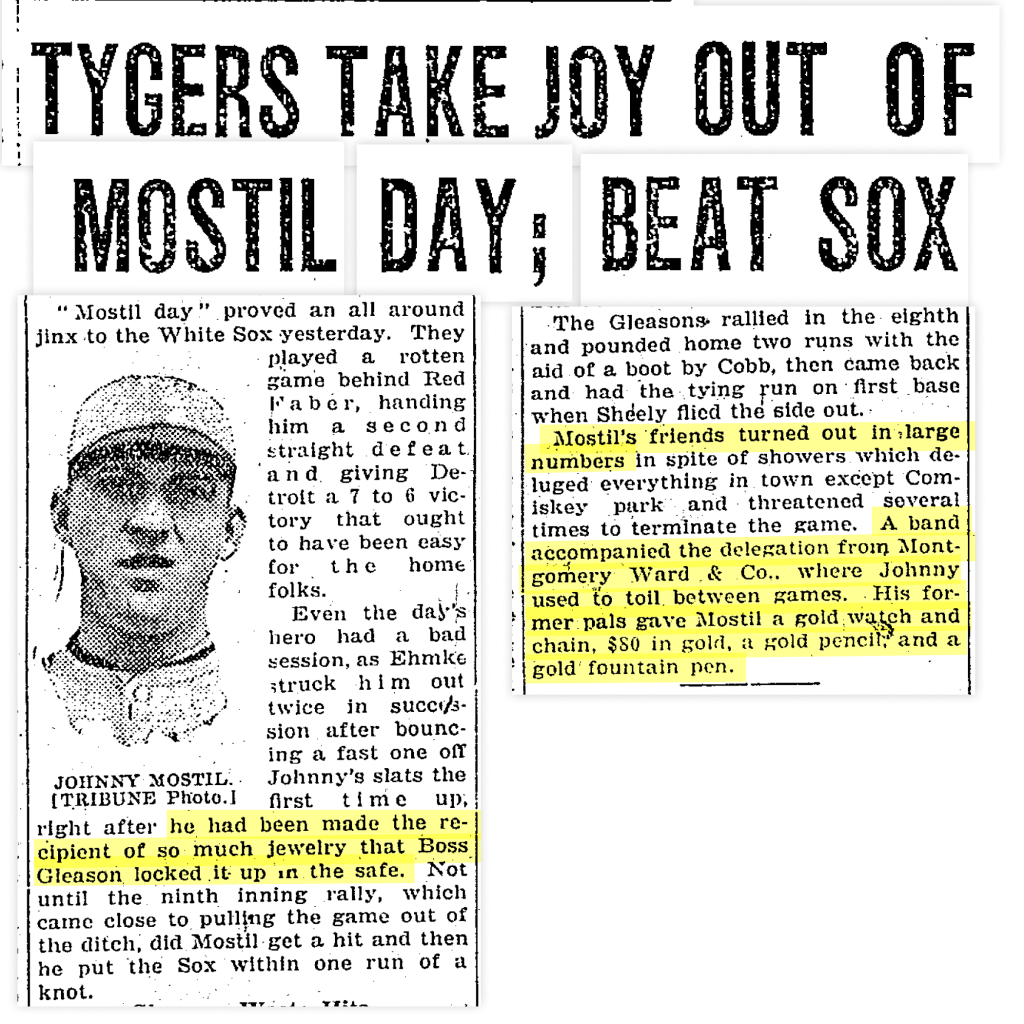
“Mostil day” proved an all around jinx to the White Sox yesterday. They played a rotten game behind Red Faber, handing him a second straight defeat and giving Detroit a 7 to 6 victory that ought to have been easy for the home folks.
Even the day’s hero had a bad session, as Ehmke struck him out twice in succession after bouncing a fast one off Johnny’s slats the first time up, right after he had been made the recipient of so much jewelry that Boss Gleason locked it up in the safe.
Mostil’s friends turned out in large numbers in spite of showers which deluged everything in town except Comiskey park and threatened several times to terminate the game. A band accompanied the delegation from Montgomery Ward & Co., where Johnny used to toil between games. His former pals gave Mostil a gold watch and chain, $80 in gold, a gold pencil, and a gold fountain pen.
Johnny Mostil has a SABR profile that explains his popularity.
By 1921 most of Chicago’s top players had been banned from baseball for conspiring to throw the World Series. The effects were disastrous as the Sox would finish in the second division for nearly two decades. Disgusted with the entire affair, many fans turned their attentions elsewhere. Mostil gave loyal patrons something to cheer for.
A patient batsman with a keen eye, Mostil cracked the .300 mark four times between 1921 and 1926. He was fearless at the plate, getting hit by more pitches than any of his American League peers on three occasions. In his first few seasons, he was often used as a fifth- or sixth-slot hitter. When he later emerged as a threat on the basepaths, he was moved to the top of the batting order. He would lead the league in stolen bases twice as a leadoff man.
In 1921, the White Sox was rebuilding not just its roster but its reputation, with new players like Johnny Mostil giving fans something to cheer for amid the disappointment of the scandal.
And the same Chicago Tribune article does mention Cy Twombly as the “newest slab rookie in the bunch” implying that the White Sox have a lot of rookies.
The art of memory
What makes this story particularly compelling is how it bridges two seemingly disparate worlds. The father’s brief moment in baseball history would later be overshadowed by his son’s artistic legacy, yet both Cy Twomblys contributed to American cultural history in their own unique ways. The pitcher’s story, largely forgotten until now, adds an unexpected dimension to his son’s artistic narrative.
The connection between these two Cy Twomblys reminds us that baseball, like art, is about more than just statistics or technique – it’s about stories, emotions, and the unexpected connections that make both sports and art so endlessly fascinating.